
Berries & honey breakfast bowl
A big spoonful of thick yoghurt with whatever berries are in season, a drizzle of local honey and a few toasted nuts.
Thick, tangy, slow-fermented L. reuteri and L. gasseri yoghurt, made in your own kitchen from milk, a starter culture, a spoonful of inulin and time. Constant 36 is designed to hold a steady temperature through a long ferment. Set the dials to 37 °C and 36 hours, then get on with your weekend.
Our mission: make homemade cultured yoghurt an everyday ritual in every Australian kitchen.
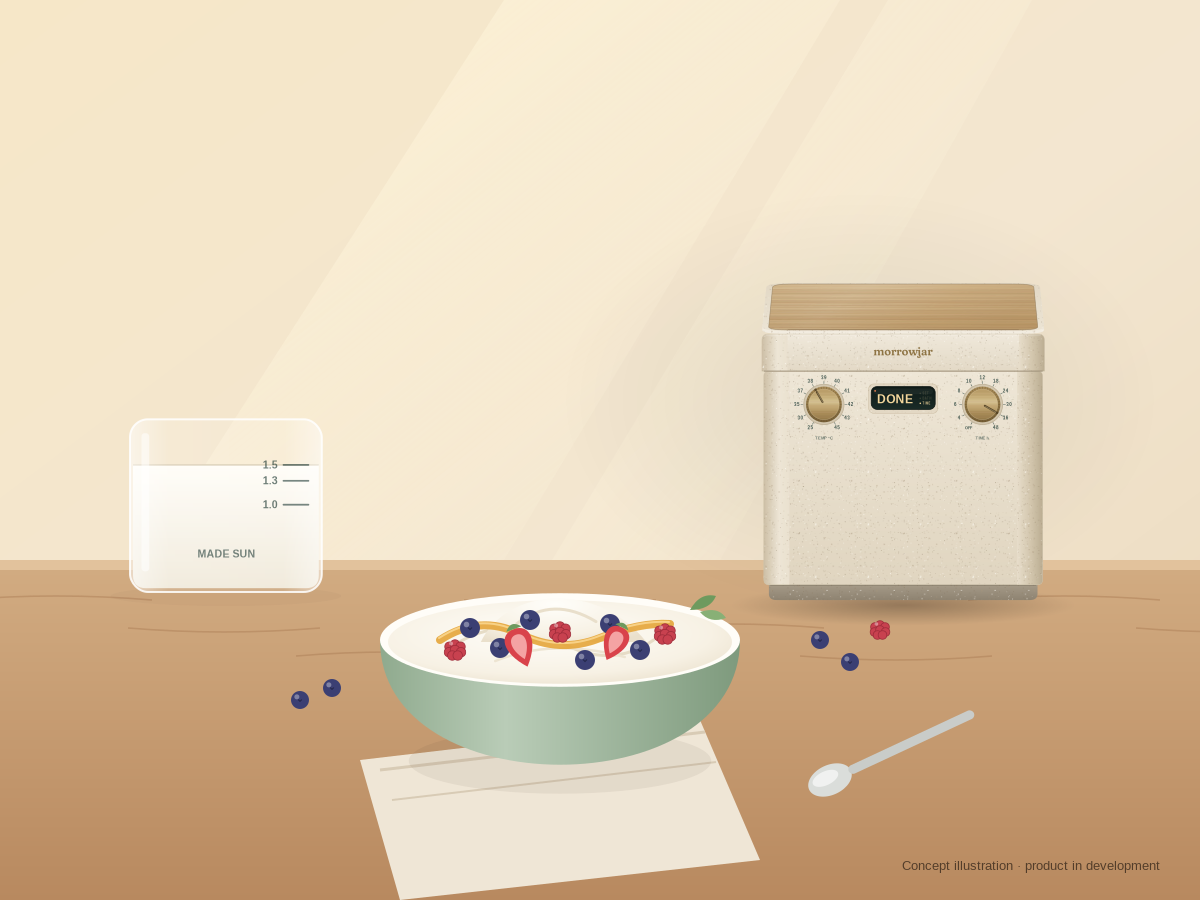
Home fermenters make long-ferment yoghurt every week. Here's why.
Milk or cream, a starter culture and a spoonful of inulin. That's it. No thickeners, sweeteners or preservatives unless you decide to add them.
Long-ferment yoghurt sits at around 37 °C for 36 hours or more, far longer than the 8–12 hours typical of regular yoghurt. Over that long, a steady temperature matters.
Longer ferments usually make a tangier yoghurt. Spoon it straight, or strain it for a thick, Greek-style texture that holds its shape.
Once you have the maker, an all-milk 1.5 kg batch costs less than half the price of plain natural yoghurt at Coles, including starter (one fresh starter, reused as its seller suggests, up to 5 batches): about $2.50 in full-cream milk, up to about $1.90 of starter and up to about 75c of power (our estimate), so up to about $5.10. The same weight of bought yoghurt costs about $11.30–$13.50. With optional cream, as in our recipe, it's up to about $7.90. Prices checked 9 Oct 2026.*
L. reuteri, L. gasseri, other long ferments, classic or Greek, with dairy, A2 or coconut milk. Set the temperature and time on the two dials to suit.
Pass a spoonful of starter to a friend, swap recipes and compare how your batches turned out.
*Prices checked at coles.com.au on 9 Oct 2026, using normal shelf prices (not specials); prices change often. Milk: Coles Full Cream Milk 3 L, $4.95 ($1.65/L), used pro rata (1.5 L, or 1.25 L with cream). Cream (optional): Dairy Farmers Pure Cream 500 ml, $6.45 ($12.90/L), used pro rata for about 250 ml. Bought yoghurt: 1.5 kg of plain natural (not Greek-style), unsweetened yoghurt at Coles unit prices, from Vaalia Natural 900 g ($6.80) to Jalna Pot Set 99% Fat Free Yoghurt Natural 1 kg ($9.00); lactose-free products excluded. Power: our estimate of at most 1.8 kWh for a 36-hour run, at 41.5c/kWh, the highest state average usage rate in Canstar's table dated 4 Sep 2026. Starter: we count one fresh starter culture, reused as its seller suggests, up to 5 batches. Luvele says "we recommend starting a fresh mother batch after 4-5 re-inoculations", and Nourishme Organics says to "return to a fresh starter culture every several generations". Per 1.5 L batch, from starters whose sellers say they can be reused (checked 9 Oct 2026): Nourishme Organics long-ferment starter, $27.99 for 3 sachets, about $1.87 over 5 batches; Mad Millie Yoghurt Culture, $13.95 for 5 sachets, about 93c, because Mad Millie says to reculture it "a maximum of 2 further times" (3 batches). The card uses the top figure. Inulin is not included.
That's our mission. Making yoghurt at home shouldn't mean a thermometer taped to a jar or the oven tied up all weekend. We want it to be as ordinary as baking bread.
Reserving is free, and the founders price is $99 for the first 300 to reserve, plus delivery. Delivery is currently A$22 flat Australia-wide (incl. GST). We'll confirm the delivery cost before you pay.
We'll share recipes, starter tips and troubleshooting help openly. We'd rather help you make a good first batch than sell you extras.
We're designing Constant 36 ourselves, with no design agency, and will build it with manufacturing partners. We're sharing the test rig, the temperature logs and the setbacks as we go.
We'll judge ourselves by how many people are still making yoghurt six months on, not just by how many makers we sell.
Ten minutes of mixing, then the slow part happens on its own. Set the dials to 37 °C and 36 hours, and a Friday 8 pm start finishes around Sunday morning.
Stir your starter and a spoonful of inulin into the milk, pour it into the jar, and set the dials to 37 °C and 36 hours.
Beach, footy, farmers market. No checking thermometers. We're designing the timer to start only once the bath is warm, and the temperature to stay steady.
It beeps when it's done (or you can switch the finish beeps off), then shows DONE. Put the jar in the fridge to set, then dig in.
Up to 1.5 L of your own yoghurt for bowls, smoothies and dips. Keep two spoonfuls aside to start the next batch.
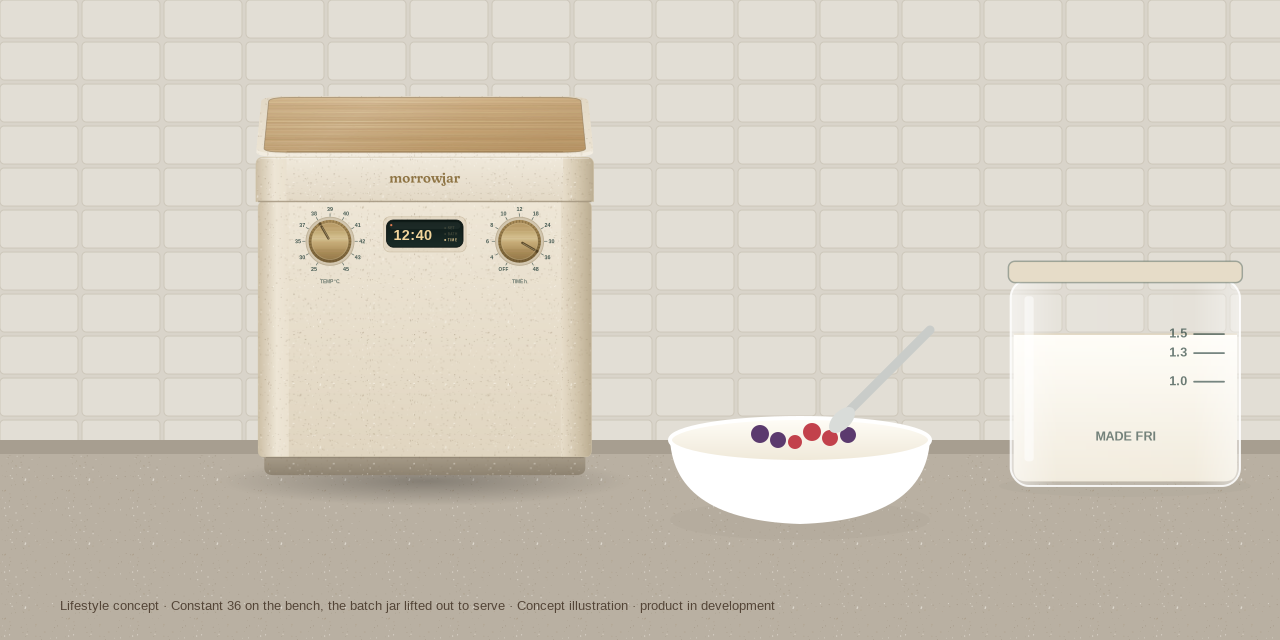
Up to 1.5 L per batch (fill marks at 1.3 and 1.5 L; a 1.0 L mark is planned, subject to testing). For example, 1.25 L of milk + about 250 ml of pure cream (optional) fills it to the 1.5 L mark. An all-milk batch is lighter and less thick. Add your chosen culture and 1–2 tablespoons of inulin, or the fibre your recipe calls for. Recipe cards come in the box.
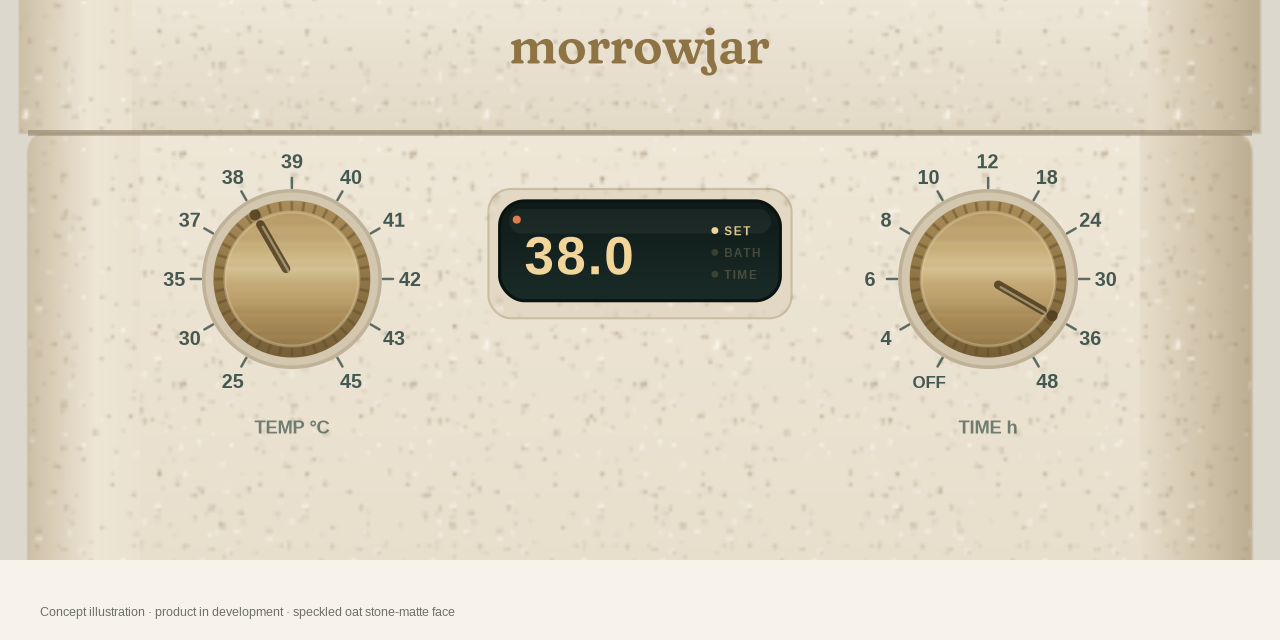
For a long ferment, set TEMP to 37 °C and TIME to 36 h. The run starts once the TIME dial has rested for 3 seconds, so there's no start button to press.
Into the fridge to set, then onto the table.
Strain it and it's thick enough to eat with a fork. It works in sweet and savoury dishes.
A big spoonful of thick yoghurt with whatever berries are in season, a drizzle of local honey and a few toasted nuts.

Blend half a cup with frozen berries, banana and a splash of milk. Breakfast you can drink on the way out the door.

Strain in the fridge for a few hours, then stir through grated cucumber, garlic, lemon and dill. Good with flatbread and crunchy veg.

Spread on a lined tray, scatter with berries and pistachios, freeze for 3 hours and snap into shards.
More ideas on the recipe cards: bircher muesli, labneh balls rolled in za'atar, creamy salad dressing, and a dollop on Sunday curry.
We've spent a lot of time reading what home fermenters say about making L. reuteri and L. gasseri yoghurt. These themes come up again and again, and they're why we're building Constant 36.
Themes we've summarised in our own words from public discussions in online fermenting communities, 2024–2026. They are not quotes or testimonials, and nobody has used Constant 36 yet.
Reusing a couple of spoonfuls from a good batch to start the next one keeps it affordable.
People end up checking the temperature with a thermometer through the night.
Sous-vide setups give steady results, but setting one up for every batch feels like a faff.
Warm is fine. Running too hot is what ruins a batch.
Reserve free today to hold the founders price and get first access to deposits. No payment is taken now. Founders get prototype updates and our test results as we go, and founders who tick the recipes box get early recipes.
Founders price: $99 plus delivery for the first 300 to reserve. Places go in reservation order: if someone doesn't place a deposit within their 14 days, their place is offered to the next person waiting, and they can still place a deposit later at the price that applies then. The founders price isn't ongoing. Once the founders places are filled, or when general sales start (whichever comes first), our planned RRP of $129 applies, and we'll update this page if that changes. We'll say plainly on this page when the founders tier is full. Prices are in AUD and include GST. Delivery is not included.
Delivery is currently A$22 flat Australia-wide (incl. GST). We'll confirm the delivery cost before you pay.
Free, no card needed. We'll email you about your reservation (progress, test results and when deposits open), plus recipes and tips if you tick the box. Unsubscribe anytime.
Your place in line decides whether you get the founders price. Only reservations for Australian delivery count towards the first 300, and if you reserve more than once with the same email, your earliest reservation counts. We'll confirm your price by email when deposits open, and hold it for 14 days. After the first 300: Planned price $129 plus delivery. Join the waitlist and we'll tell you when it's available. Australian delivery only for the first run. Delivery is currently A$22 flat Australia-wide (incl. GST). We'll confirm the delivery cost before you pay.
Outside Australia, including New Zealand? Tick "I'm outside Australia". We'll only email you about availability, when we can deliver to you. No price is held and no deposit applies.
Specifications are design targets for a product in development and may change. Nothing here is a tested performance claim yet. We'll publish full 36-hour probe logs before taking deposits, and production test results before shipping.
Most yoghurt makers are built for classic 8–12 hour yoghurt at 42–50 °C. Constant 36 is designed around the long, low ferment, and we'll publish our measured accuracy with our test logs.
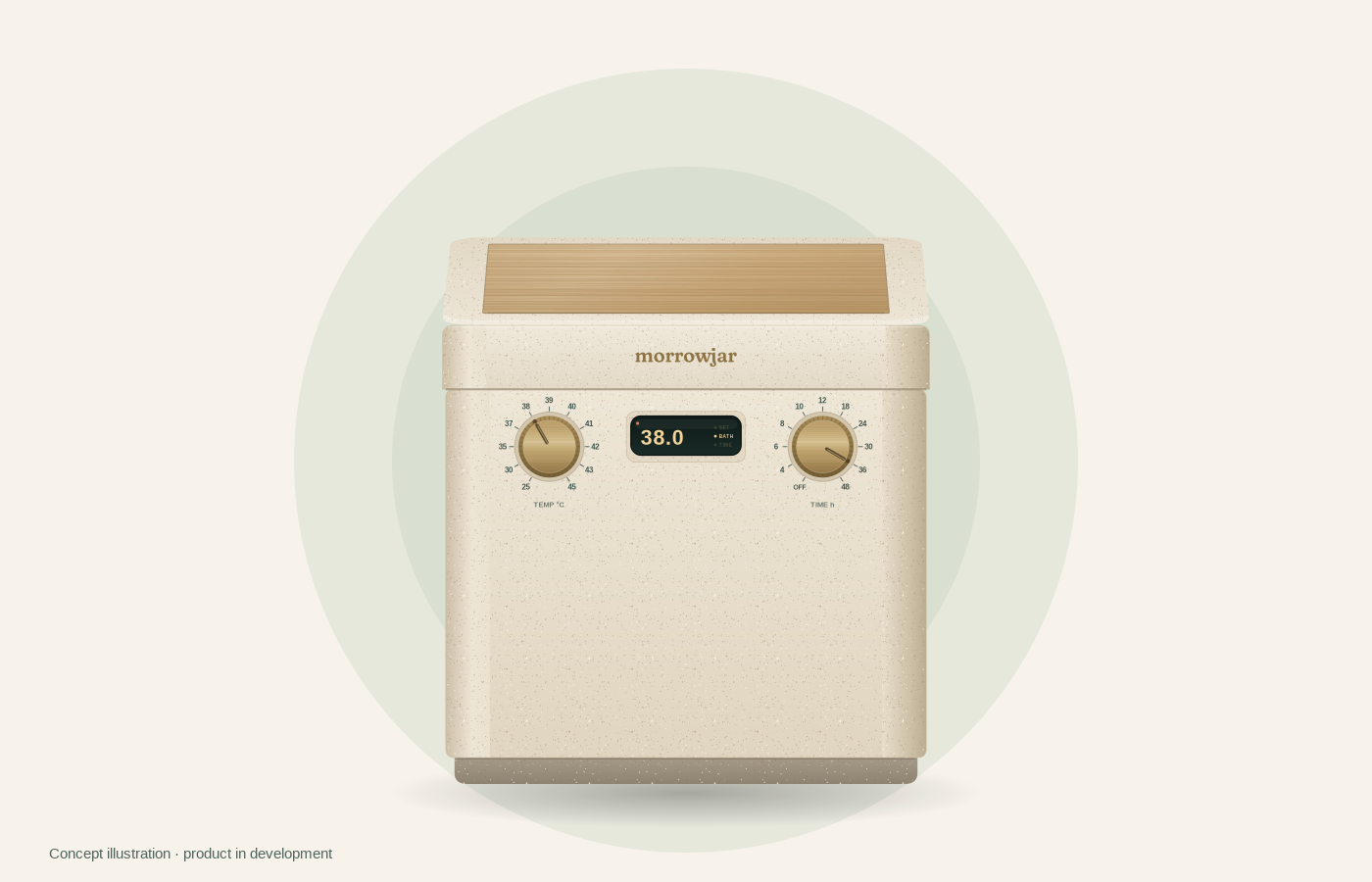
| Temperature range | 25–45 °C on the TEMP dial, one click for each number on the scale (25, 30, 35, 37 to 43, and 45 °C) |
|---|---|
| Temperature control | Design target: a steady temperature, with the display showing the actual water temperature around your jar. Full 36-hour probe logs will be published before deposits open |
| Timer | OFF, then 4–48 hours on the TIME dial (4, 6, 8, 10, 12, 18, 24, 30, 36 and 48 h). A run starts once the TIME dial has rested on a setting for 3 seconds. Design target: the countdown starts when the bath reaches temperature |
| Controls | Two dials, TEMP and TIME, plus a small readout between them. No menus and no start button: the pointer shows your setting |
| Capacity | One glass jar with fill marks at 1.3 and 1.5 L (a 1.0 L mark is planned, subject to testing); up to 1.5 L of milk per batch |
| Heating | Insulated stainless water bath, low-wattage silicone heater, closed-loop sensor in the water |
| Power | 24 V DC from the external plug-pack adapter (included), to be certified for Australia (RCM) before shipping. No mains voltage near the water |
| Size | About 22 × 22 cm footprint, up to 22.3 cm tall |
| Weight | About 2.0 kg, or about 4.5 kg in use with milk and water (estimates) |
| Box | About 24.8 × 25.3 × 23.5 cm, about 2.7 kg packed (estimates) |
| Materials | Borosilicate glass, 304 stainless steel, PP (polypropylene), food-grade silicone |
| Warranty | Details to be confirmed before deposits open. You'll always have your rights under the Australian Consumer Law. |
Up to 1.5 L of milk per batch (fill marks at 1.3 and 1.5 L; a 1.0 L mark is planned, subject to testing). For example, 1.25 L of milk + about 250 ml of pure cream (optional) fills it to the 1.5 L mark. An all-milk batch is lighter and less thick. You'll also need a starter culture of your choice, and 1–2 tablespoons of inulin (a plant fibre sold in health food shops), or whatever fibre your recipe calls for. Our recipe cards walk you through it step by step.
Treat it like any fresh homemade yoghurt. Keep it covered in the fridge and eat it within about a week. Always use clean jars and spoons.
No. Reserving is free, takes 30 seconds and needs no card. Later, and only once all of these are true (our prototype has passed its published temperature tests, we have written manufacturing quotes and a funding plan, deposits can be held in a separate account, and our terms are finalised), we'll open an optional, fully refundable A$29 deposit. We'll email you first, and your price is then held for 14 days so you can decide. Founders price: $99 plus delivery for the first 300 to reserve. Delivery is currently A$22 flat Australia-wide (incl. GST). We'll confirm the delivery cost before you pay. Places go in reservation order: if someone doesn't place a deposit within their 14 days, their place is offered to the next person waiting, and they can still place a deposit later at the price that applies then. No date is set yet, and no money is taken today.
Constant 36 is in development (prototype stage). Our current estimate for first deliveries is the first half of 2028. It's an estimate, not a promise: it depends on finishing prototype testing, factory tooling, Australian certification and funding. We'll share progress, test logs and any change to the date by email, as soon as we know.
It's designed around long, low ferments like L. reuteri (set the dials to 37 °C and 36 hours) and L. gasseri (around 42 °C), plus classic and Greek-style yoghurt, dairy-free ferments, and other ferments that need a steady temperature between 25 and 45 °C (our design range).
Not in the first production run, which is for Australian delivery only. If you're outside Australia, tick "I'm outside Australia" in the form and we'll email you only when we can deliver to you. No price is held and no deposit applies.
Morrowjar (operated by Josh Cameron), a small start-up based in South-East Queensland. We design Constant 36 in-house, with no design agency, and will build it with manufacturing partners. We share our test rig, temperature logs and setbacks as we go.
No. Use a starter culture you trust, or a spoonful of your last batch (most culture sellers suggest a fresh starter every few batches). Our recipe cards explain how.
No. Constant 36 is a kitchen appliance, and what it makes is food. We don't make health claims about it or about yoghurt. If you're managing a health condition, talk to your doctor or health professional about what's right for you.
You can cancel your reservation any time by replying to any of our emails. If you later pay the A$29 deposit, it's fully refundable any time until your unit ships, including if the delivery estimate changes.
Long ferments are unforgiving. Some cultures struggle when the temperature runs a few degrees too hot, and many makers drift during warm-up. We're designing Constant 36 to measure the water around your jar and keep it steady, and we'll publish full 36-hour probe logs before taking deposits.
Water carries heat evenly around the whole jar, much more evenly than warm air does. Ours is insulated to help keep the warmth in.
The appliance runs on 24 V DC, and mains power stays inside the plug-pack adapter. The heater sits outside the stainless basin, and the design includes two independent hardware cut-outs that back up the software. Constant 36 and its adapter will meet Australian electrical safety and EMC requirements (RCM) before any unit ships.
Constant 36 is a kitchen appliance for making yoghurt and other fermented foods, and what you make with it is food. We don't make health claims, and nothing on this site is medical or nutritional advice. If you're managing a health condition, please talk to your doctor or health professional.